Short answer: You talk to a real person, and a crew is usually at your door within the hour. We stop the water, map every wet area with meters and a thermal camera, and walk you through a written scope before we touch anything. Then we extract, remove what can't be saved, set up drying equipment, check readings every day until the structure meets the dry standard, document that clearance for your insurer, and rebuild what was removed. One company, one point of contact, from the first call to the final walkthrough.
Most people call us on the worst day they've had in that house. The basement is ankle-deep, the ceiling is dripping, or the carpet squishes under your feet and you have no idea how far the water went. The second question we hear, right after "how fast can you get here," is "what happens now?"
This post answers that one. I run both sides of the company, the mitigation crews that dry your home and the reconstruction team that puts it back together, so this is the same walkthrough I'd give a neighbor. No jargon you won't get explained, no surprises later.
Key takeaways
- Help is usually on site within the hour, 24/7, across Oakland, Macomb and Wayne County.
- Nothing gets torn out until you've seen the moisture map and agreed to the scope.
- Most structures dry in 3 to 5 days. We take readings every day and adjust the equipment as the numbers move.
- "Dry" is a measured result, not a guess. You get a written drying log your adjuster can rely on.
- The same team that dries your home can rebuild it, so nothing falls through the gap between contractors.
The whole process at a glance
| Stage | Typical timing | What happens | What you get |
|---|---|---|---|
| 1. The call | Minutes | Safety questions, shutoff guidance, crew dispatched | An arrival window and a name |
| 2. Arrival & inspection | Usually within the hour | Source stopped, moisture mapped, water category and class assessed | A clear picture of how far the water went |
| 3. Estimate & scope | First visit | Written scope, insurance documentation, your signed authorization | A plan you understand before work starts |
| 4. Mitigation | Day 1 | Extraction, removal of unsalvageable materials, contents protected | Standing water gone, damage contained |
| 5. Equipment setup | Day 1 | Dehumidifiers, air movers, air scrubbers, specialty drying | A drying system sized to your loss |
| 6. Daily monitoring | Days 2 to 5 (typical) | Readings logged, equipment moved or removed as areas dry | Daily progress you can see |
| 7. Post-clearance | When targets are met | Final readings, equipment pulled, testing if mold was involved | A documented dry standard for your file |
| 8. Rebuild | After approval, scope-dependent | Drywall, flooring, cabinets, paint, trim, final walkthrough | Your space back, finished |
Step 1: The call
When you dial (248) 372-1930, you reach our team, not a national call center reading a script. We answer 24 hours a day, every day of the year, including holidays.
The first few minutes are about safety and stopping the damage from getting worse. We'll ask:
- Is the water still coming in? If it's a supply line or burst pipe, we'll walk you to the main shutoff.
- Has water reached outlets, the electrical panel or appliances? If so, stay out of the water. We'll tell you whether it's safe to cut power at the breaker.
- Where did it come from? A clean supply line, a sump pump, a sewer backup and a roof leak are handled differently, and the source affects your insurance coverage.
- Roughly how big is the affected area? This tells us how much equipment to put on the truck so the crew arrives ready.
Before we hang up, you'll know who's coming and about when. If you can do it safely, take a few photos and a short video of the damage while you wait. It helps the claim, and it's the only record of the "before" once extraction starts.
Step 2: Arrival and inspection
Our crews are usually on site within the hour anywhere in our service area. The first thing they do is confirm the source is stopped and the space is safe to work in. Then they find out where the water actually went, which is almost always farther than it looks.
Water wicks up drywall, runs under baseboards, soaks into carpet pad and travels along subfloors into rooms that look perfectly dry. So we don't eyeball it. Our technicians use:
- Thermal imaging cameras to spot the temperature differences wet materials create behind walls and under floors.
- Calibrated moisture meters, both pin and pinless, to confirm what the camera suggests and take a baseline reading for each material.
- Thermo-hygrometers to measure temperature and relative humidity, which tells us how much moisture is in the air and how hard the drying system will have to work.
We also take readings from unaffected areas of the same materials. Those "dry reference" numbers become the target. Everything we measure later is compared against them.
Finally, we classify the loss under the IICRC S500 standard. The category describes how contaminated the water is: Category 1 is clean water from a supply line, Category 2 carries contaminants (a washing machine or dishwasher overflow), and Category 3 is grossly contaminated, such as sewage or outside floodwater. The class describes how much water there is and how much it soaked into. Both decide what can be dried in place and what has to be removed.
Older home? Many Metro Detroit houses built before the 1980s have plaster, joint compound, floor tile or pipe insulation that may contain asbestos. If we need to remove those materials, we test first. Revive is equipped for asbestos removal when testing comes back positive, so your job doesn't stall waiting on another contractor.
Step 3: The estimate and scope of work
Before anything comes out of your home, we sit down with you and explain what we found. You'll see the moisture map, what we can dry in place, what needs to be removed and why, and the equipment we plan to set up. If you've got questions, this is the time. We'd rather spend ten extra minutes now than have you wondering why a wall is open.
Then we document the loss the way insurance carriers expect: photos of every affected area, the moisture readings, the water category and class, and a line-item scope of the mitigation work. You sign a work authorization so we can get started, and we take it from there with your carrier.
- We bill your insurance directly on covered claims. You're responsible for your deductible and anything the policy doesn't cover, and we'll tell you if we see something that might not be.
- We talk to the adjuster for you. We send the documentation, answer their questions, and meet them on site when they want to see the loss.
- The choice of contractor is yours. Your insurer may suggest a preferred vendor, but you're allowed to choose who works in your home.
No insurance claim, or a small loss under your deductible? We'll give you a straightforward estimate and the same process.
Step 4: Mitigation, stopping the damage
Mitigation is everything we do to keep the damage from spreading. It starts the same day.
Water extraction
Standing water comes out first, with truck-mounted or portable extractors depending on the job. Extraction removes far more water than any amount of fans ever will, so it's the single biggest factor in how fast the rest of your home dries. On carpet, weighted extraction tools pull water out of the pad as well as the surface.
Controlled removal
Some materials can't be saved, and drying them only wastes days. Saturated carpet pad, swollen laminate, particleboard and, in Category 3 losses, porous materials like drywall and carpet are removed. When wall material has to go, we make a straight "flood cut" a little above where the moisture readings stop. A clean, level cut lets the cavity dry, keeps the wall solid above it, and makes the rebuild faster and cleaner.
We only remove what the readings and the water category justify. Anything that can be dried in place, stays.
Protecting your belongings
Furniture is moved out of the water or blocked up on pads so legs don't stain or swell. Rugs, photos, documents, electronics and anything sentimental are handled carefully. When a room needs to be cleared completely, our contents cleaning and restoration team can pack out, inventory, clean and store your belongings until the space is ready.
Cleaning and containment
Affected surfaces are cleaned and treated with an antimicrobial where the situation calls for it. For sewage, flood water or any visible mold, we set up containment with plastic barriers and HEPA air filtration so contaminants stay in the work area and out of the rest of your home.
Step 5: Drying equipment setup
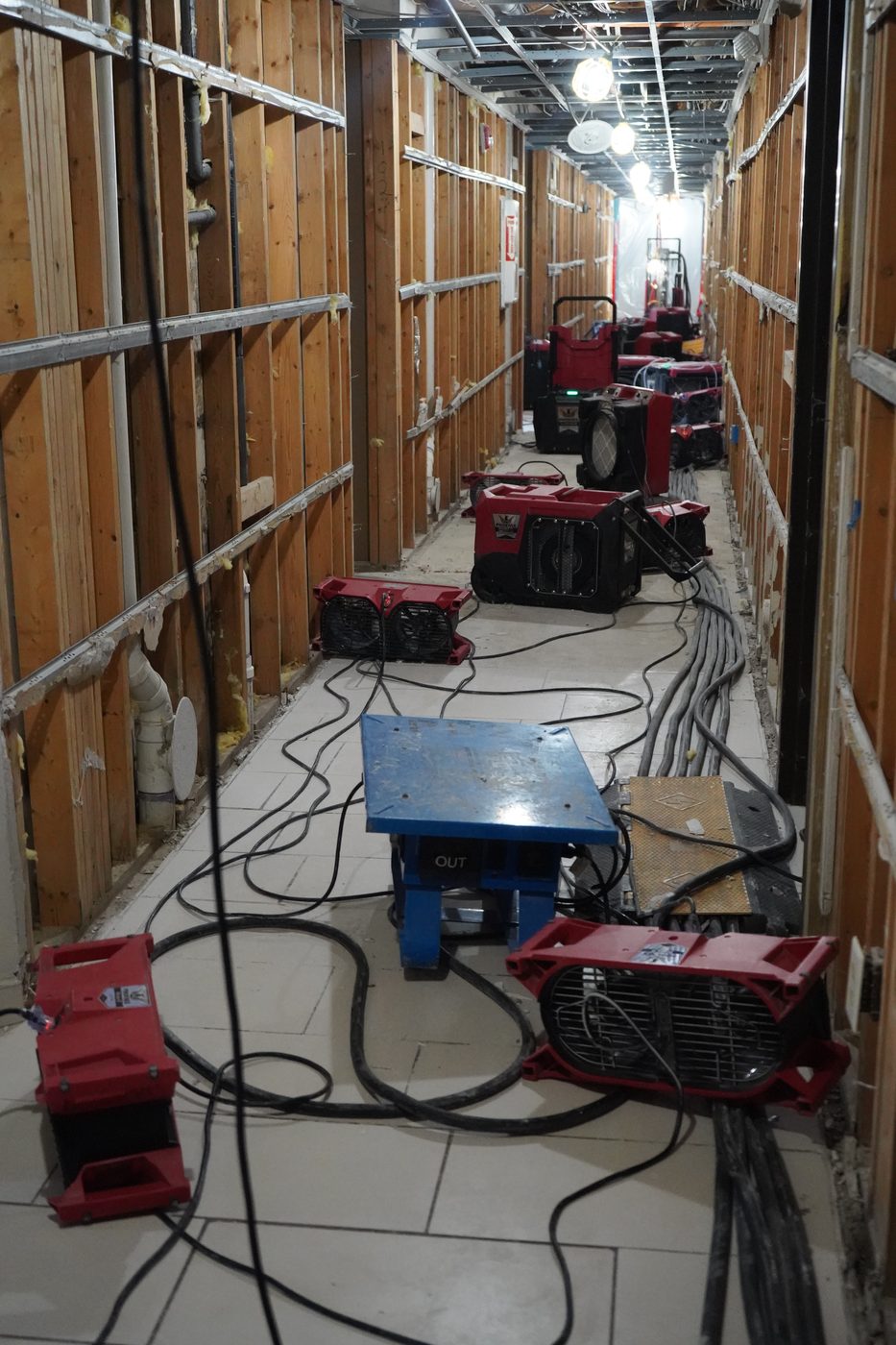
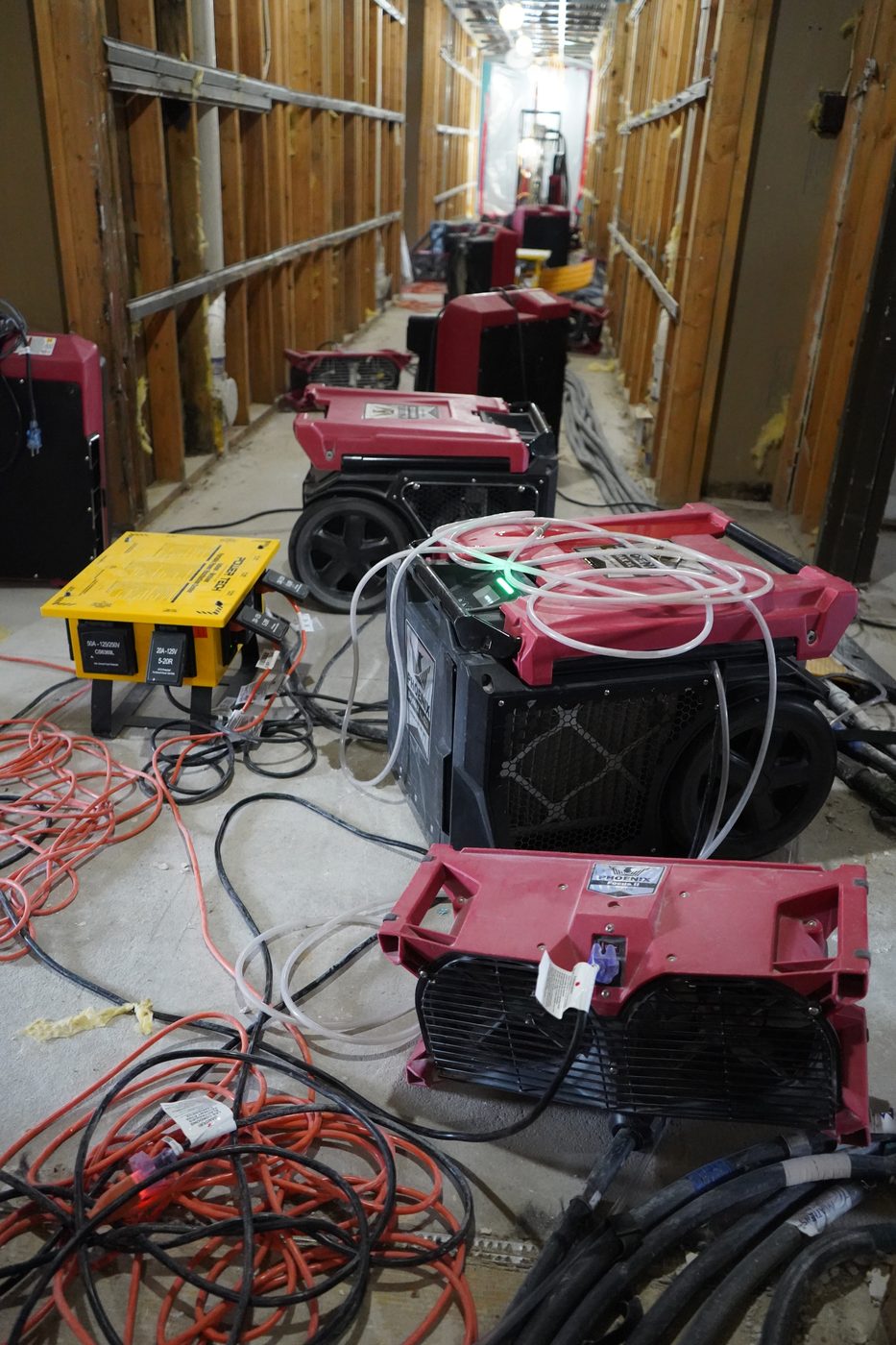
This is the part people remember: the hum. Drying a structure is a science problem, and the equipment is how we solve it. Every setup is sized to your specific loss using the square footage, the materials, the class of water and the temperature and humidity readings from step 2.
- Low-grain refrigerant (LGR) dehumidifiers pull moisture out of the air, often dozens of gallons a day on a large loss. They're the engine of the whole system.
- Air movers push dry air across wet surfaces at high velocity, which speeds up evaporation. They're angled along walls and floors in a specific pattern, not just pointed at the room.
- HEPA air scrubbers filter fine particles, spores and odors from the air, especially important with contaminated water or mold.
- Specialty drying systems for hard cases. Injection systems push air into wall cavities and behind cabinets so we can often dry them without tearing them out. Drying mats pull moisture up through hardwood floors.
We spread the equipment across your circuits so nothing trips, and on large losses, or when the power is out, we bring a generator. You'll get a short rundown before the crew leaves of what's running, why it's there, and who to call with questions.
Living with drying equipment: Please don't turn it off or move it, even at night. Every hour it's off adds drying time. Keep windows and exterior doors closed so we're not drying the whole outdoors, keep the thermostat somewhere in the low to mid 70s, and keep kids and pets away from cords. If something stops running or a breaker trips, call us. We'd rather come out than lose a day.
Step 6: Daily monitoring
A drying job isn't "set it and forget it." A technician comes back every day, usually for 3 to 5 days, and checks the same spots, with the same meters, against those dry reference readings from day one. They record:
- Moisture content of the walls, floors, framing and subfloor at each mapped point
- Temperature and humidity inside the drying area, outside it, and coming out of each dehumidifier
- How the numbers changed since yesterday
Then we adjust. Air movers get moved as some areas dry and others lag. A dehumidifier gets added if the air isn't drying fast enough, or pulled once the load drops. Equipment comes out of rooms that hit their targets, which keeps your electric bill and the noise down. If a spot isn't responding the way it should, that's a signal there's more water hidden somewhere, and we go find it.
Every one of those visits goes into the drying log. It's the proof, for you and for your adjuster, that the job was done right.
Step 7: Post-clearance, confirming it's actually dry
"It feels dry" isn't good enough. Drywall can feel dry to the touch while the framing behind it is still wet enough to grow mold. So the job is only finished when the readings say it is.
Clearance means every mapped area has reached the dry standard, matching or coming very close to the readings from unaffected materials of the same type. We take a final round of readings, photograph them, pull the equipment and close out the drying log. That documentation goes in your claim file and stays with your home's records.
If mold was part of the job, there's one more step. After mold remediation, we recommend post-remediation verification by an independent assessor, who inspects the work area and may take air or surface samples before containment comes down. Some insurers and buyers ask for it, and it gives you an unbiased answer about whether the space is clean.

Step 8: The rebuild
Once your home is dry and cleared, it's time to put it back. This is where a lot of homeowners get stuck: the mitigation company leaves, and now they have to find a contractor, get new bids, and explain the claim all over again. With Revive, the rebuild is handled by the same company, working from the same documentation, under a Michigan residential builder's license.
Here's how it goes:
- Rebuild scope and approval. We write up what needs to be replaced, from drywall and insulation to flooring, cabinets, trim and paint, and work it through your insurance claim.
- Selections. We match what was there as closely as possible: flooring, cabinet style, trim profile, paint color. If you'd like to upgrade while the walls are open, we'll price the difference separately so it's clear what insurance pays and what you do.
- Construction. Insulation, drywall, finishing and texture, paint, flooring, cabinets and trim. You'll know the schedule and who's on site each day.
- Final walkthrough. We walk the finished space with you and fix anything on your list before we call it done.
How long the rebuild takes depends on the size of the job, material lead times and how quickly the claim is approved. A basement with a flood cut and new flooring often moves in a couple of weeks once approved. Kitchens, custom cabinetry and multi-room losses take longer. We'll give you a real timeline for your project, not a best case.
What you can do to help the process
- Call your insurance company to open the claim, and pass us the claim number and adjuster's contact once you have them.
- Keep receipts for anything you spend because of the loss, like hotel nights or emergency purchases. Many policies reimburse them.
- Don't throw out damaged belongings before they're photographed and listed. The adjuster may need to see them.
- Leave the equipment running and the windows closed until we tell you otherwise.
- Tell us about anything new: a smell, a stain spreading, a floor that starts to cup. Early is always better.
Water damage right now? We answer 24/7.
Revive Restoration is family-owned and based in Farmington Hills. Our IICRC-certified crews are usually on site within the hour across Oakland, Macomb and Wayne County. We handle it from the first call through the final walkthrough, and bill your insurance directly.
Frequently asked questions
How fast will Revive get to my home?
Usually within the hour, 24 hours a day, anywhere in Oakland, Macomb and Wayne County. When you call, you talk to our team directly and get an arrival window before you hang up.
How long does the drying process take?
Most homes reach the dry standard in 3 to 5 days. Hardwood floors, plaster, concrete and large or heavily saturated losses can take longer. A technician takes readings every day, so you always know where things stand.
Can I stay in my home while the equipment is running?
Usually, yes. The equipment is loud and the drying area will be warm, but most families stay home during a clean-water loss. With sewage, flood water or mold, we may recommend keeping people and pets out of the work area, and in some cases out of the home, until it is safe.
Can I turn the drying equipment off at night?
Please don't. Every hour the dehumidifiers and air movers are off adds drying time and gives moisture a chance to settle back into materials. If the noise is a real problem or a breaker trips, call us and we will adjust the setup.
Do I have to use the restoration company my insurance recommends?
No. Your insurer may suggest a preferred vendor, but the choice of contractor is yours. Revive works with all major carriers, bills insurance directly on covered claims and handles the documentation and adjuster communication.
Do you handle the rebuild too, or just the drying?
Both. Revive handles mitigation and reconstruction under one roof, working from the same documentation and claim. That means one point of contact from the first call through drywall, flooring, cabinets, paint and the final walkthrough.
Sources
- IICRC S500 Standard for Professional Water Damage Restoration (water categories, classes and drying standards)
- IICRC S520 Standard for Professional Mold Remediation (containment and post-remediation verification)
- U.S. Environmental Protection Agency, Mold cleanup in your home (24 to 48 hour drying window)
- U.S. Environmental Protection Agency, Protect your family from exposures to asbestos
Timelines in this article are typical ranges, not guarantees. Every loss is different, and drying and rebuild times depend on the materials involved, the extent of the damage and insurance approvals. Coverage depends on your policy; confirm details with your insurance agent.